 DEZAIR
Capability, Practice & Learning
Recognition, rehearsal, deliberate practice, retention, automaticity, confidence calibration, transfer, and deletion.
How does judgment become reliable without turning into over-analysis?
START HERE
A deliberate first sequence
Foundational pieces first—not simply the newest publications.
- 01Research Synthesis · 7 MIN→
Why Knowing What To Do Isn't the Same As Doing It
You can explain exactly what you should have done, five minutes after you didn't do it. That gap has a name, three distinct causes, and none of them are "just anxiety."
- 02Method Note · 4 MIN→
The Three Ways Good Judgment Fails Under Pressure
"Try harder" assumes one problem. There are actually three separate ways judgment fails under pressure, and each one needs a completely different fix.
- 03Field Note · 3 MIN→
You Knew The Right Move. You Did The Wrong One Anyway.
You noticed exactly when to slow down. You knew it clearly. Then you didn't. Here's why that specific gap isn't a knowledge problem, and isn't fixed like one.
- 04Method Note · 8 MIN→
The 3-Encounter Audit
You’ve read the framework. You understand the Loop. You know the Six Patterns. You’ve spent the last two weeks consciously tracking her breath, holding your pace, and trying not to escalate when the monitor in your head screams at you to...
KEY DISTINCTIONS
Terms that keep the question precise
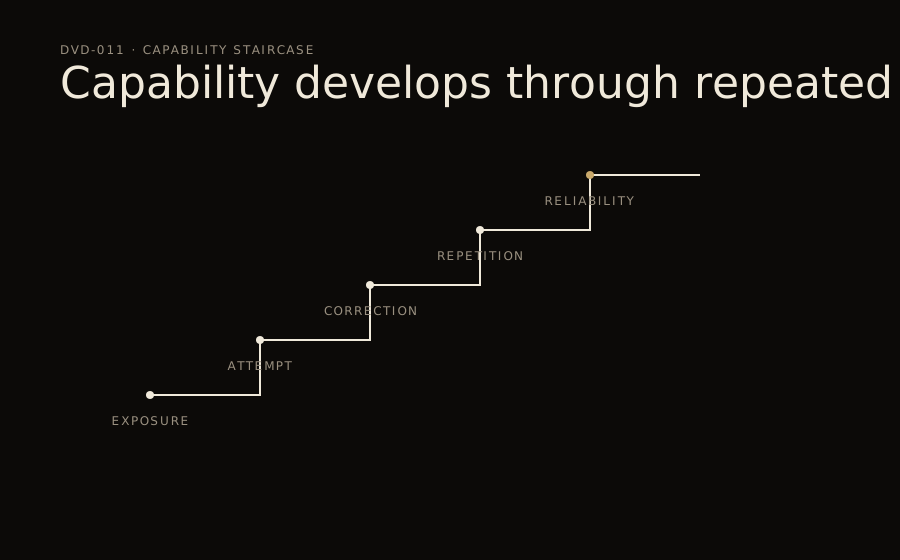
Distinguish knowing from reliable performance and use practice that reduces conscious framework dependence over time.
- Recognition
- Noticing the relevant feature of a situation.
- Decision
- Selecting an action that fits the evidence and constraints.
- Execution
- Carrying out the decision reliably under real conditions.
COMMON PROBLEMS
Enter through the situation
Each question resolves to a real publication in the current Library.
TOOLS / FIELD DESK
When reading is not the next job
Use a bounded instrument to structure your own evidence or decision.
TRAINING
Sexual Fieldcraft
Uses rehearsal and correction to build reliable execution.
View the program dossier →LATEST
Recent work in this domain
Dates reflect real publication records.
ALL PUBLICATIONS IN THIS TOPIC
Primary-domain archive
5 publications whose central question is owned here. Secondary-domain links remain available through article orientation.
You Knew The Right Move. You Did The Wrong One Anyway.
You noticed exactly when to slow down. You knew it clearly. Then you didn't. Here's why that specific gap isn't a knowledge problem, and isn't fixed like one.
The Three Ways Good Judgment Fails Under Pressure
"Try harder" assumes one problem. There are actually three separate ways judgment fails under pressure, and each one needs a completely different fix.
Why Knowing What To Do Isn't the Same As Doing It
You can explain exactly what you should have done, five minutes after you didn't do it. That gap has a name, three distinct causes, and none of them are "just anxiety."
The Time-Distortion Drill
You've read the framework. You accept the physiology: the build is a loading process, and the loading takes twenty to forty minutes. You believe it. You mean it.
The 3-Encounter Audit
You’ve read the framework. You understand the Loop. You know the Six Patterns. You’ve spent the last two weeks consciously tracking her breath, holding your pace, and trying not to escalate when the monitor in your head screams at you to...