 DEZAIR

DEZAIR KNOWLEDGE ATLAS
Topics
Twelve domains organize what the Institute studies. Topics map the subject; the Library contains the publications.
START FROM A QUESTION
Enter in ordinary language.
You do not need to know the Institute’s taxonomy before you begin.
HOW THE MAP WORKS
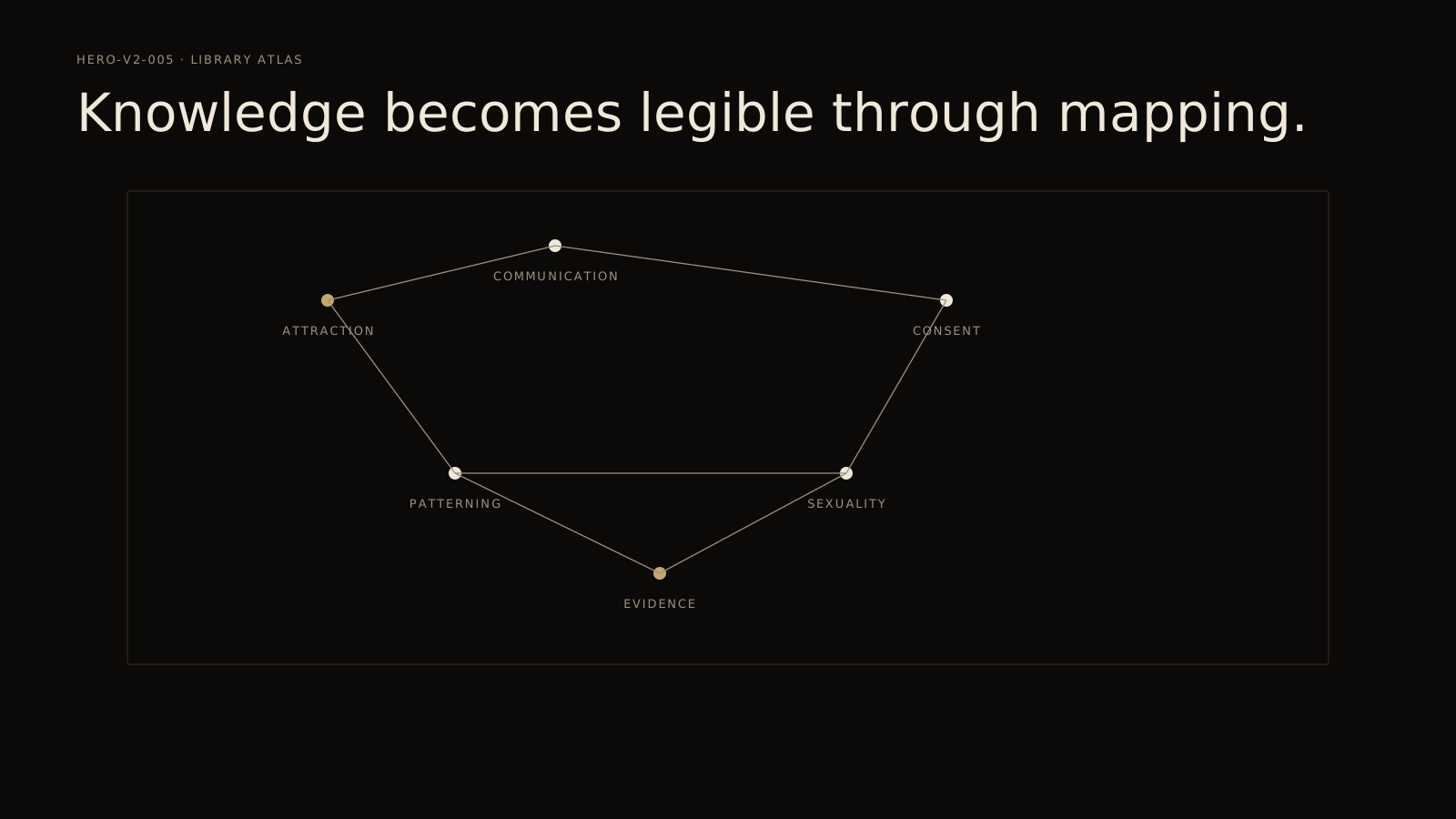
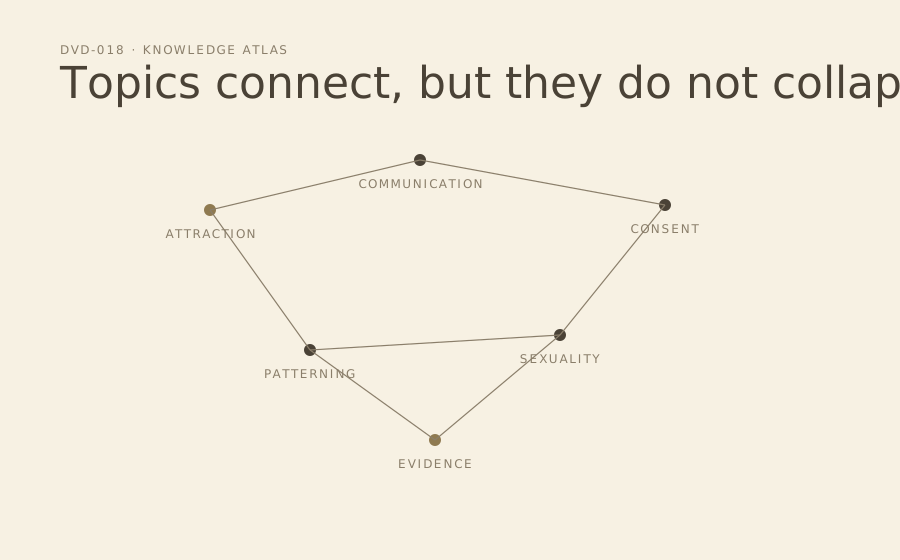
Topics connect. They do not collapse.
Observation shapes every read. Mutuality changes what pursuit can justify. Consent places a hard boundary on inference. Desire, state, relationship systems, repair, and practice answer different questions inside the same field.
12 CANONICAL DOMAINS
What DEZAIR studies
Each hub gives you a question, starting sequence, distinctions, problems, and connected knowledge—not an unfiltered article dump.
- 01→
Observation & Interpretation
What actually happened, and what am I adding to it?
Observation, inference, uncertainty, competing explanations, confidence, pattern accumulation, and revision. - 02→
Mutuality & Reciprocity
Is the interaction being carried by both people?
Courtesy, participation, extension, re-initiation, mutual investment, symmetry, direction, and contribution. - 03→
Attraction, Pursuit & Decision
What does the available evidence justify doing next?
Motive, context, investment, invitation, holding, exiting, uncertainty, and proportionate action. - 04→
Desire
What conditions affect whether desire appears, grows, weakens, or disappears?
Spontaneous and responsive desire, desire discrepancy, stress, resentment, novelty, routine, initiation, and long-term change. - 05→
State, Arousal & Attention
What is changing in the interaction, and how confidently can we read it?
State change, engagement, plateau, deepening, attention, ambiguity, multi-channel reading, and transition. - 06→
Communication & Difficult Conversations
When is inference no longer enough, and how do we talk clearly?
Asking, preference and desire conversations, feedback, boundaries, uncertainty, and requests without pressure. - 07→
Consent, Boundaries & Agency
What outranks inference, and where must interpretation stop?
Explicit boundaries, ongoing consent, uncertainty, agency, power, disengagement, and the limits of behavioral inference. - 08→
Touch, Pacing & Intimate Execution
How do pacing, repetition, intensity, and change affect the quality of an intimate interaction?
Pacing, intensity, staying, changing one variable, repetition, execution, performance pressure, and feedback. - 09→
Relationship Patterns & Systems
What keeps repeating between us, and what is maintaining it?
Recurring loops, resentment, asymmetry, covert contracts, routine, conflict cycles, distance, and responsibility. - 10→
Repair & Recalibration
Something went wrong. What needs to happen before anything else can improve?
Rupture, acknowledgment, responsibility, clarification, safety, space, revising a read, and restarting. - 11→
Capability, Practice & Learning
How does judgment become reliable without turning into over-analysis?
Recognition, rehearsal, deliberate practice, retention, automaticity, confidence calibration, transfer, and deletion. - 12→
Sustained Intimacy & Long-Term Stewardship
How do couples maintain, repair, and periodically rebuild intimacy over time?
Maintenance, changing seasons, desire over time, routine, reconnection, renegotiation, life transitions, and rebuilding after drift.
TOPICS / LIBRARY
Use Topics to orient. Use the Library to read.
The taxonomy helps you locate a subject. It does not replace problem-led search, the full publication archive, or Field Desk support.