 DEZAIR

Pursuit
Read the developing interaction. Know when to move, hold, or walk away.
“I’m already pursuing her. What is her behavior actually telling me?”
Pursuit is not a pre-chase philosophy book. It lives inside active pursuit — texting, meeting, re-engaging, noticing asymmetry, deciding whether to maintain, reciprocate, invite, hold or exit.
Closed sits outside the ladder and overrides it. Explicit rejection, clear disengagement or repeated unwanted contact blocks further pursuit regardless of apparent warmth or history.
Depth, symmetry, direction, confidence. Confidence acts as a ceiling — thin evidence can’t authorize a high-commitment decision, no matter how favorable it looks.
Six levels of observable, bilateral contribution.
Mapped independently for both people. Tap a level to see what it establishes — and what it doesn't.
Tap a level to see what it means — and what it doesn't.
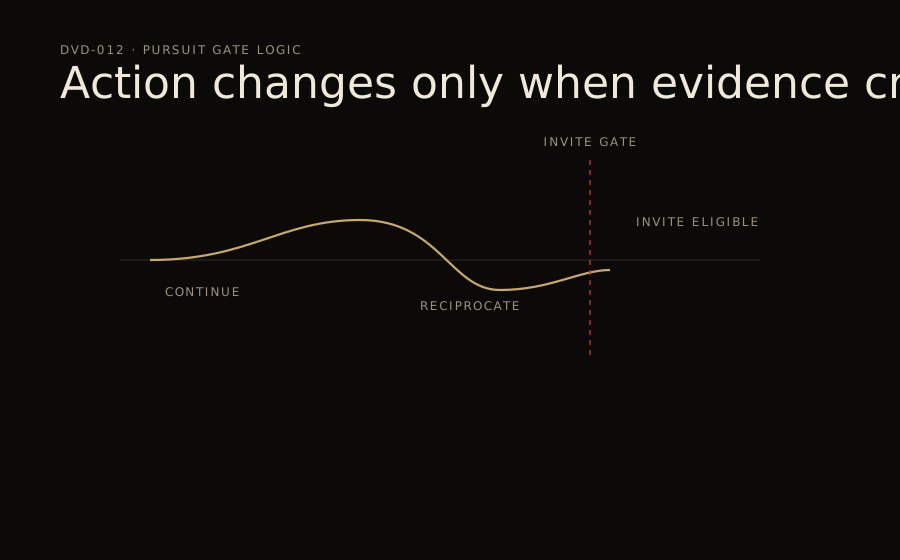
| Gate | Trigger | Principle |
|---|---|---|
| Continue | No meaningful new evidence | Maintain current investment |
| Reciprocate | Her contribution materially increases | Match it — don’t race ahead |
| Invite | Mutual investment is established | Create a clear opportunity to change state |
| Hold | Evidence is contradictory or weak | Stop increasing investment |
| Exit | Closed context or sustained non-reciprocity | Stop cleanly |
Anyone actively pursuing or getting to know someone, uncertain whether the interaction deserves more investment.
The public dossier explains the model and training intent. Structured practice, progressive cases, and implementation materials are not open for purchase in this phase.
Anyone looking for scripts, guaranteed outcomes, or a way to “make her chase.”
Not sure this is the capability you need?
Identify the underlying capability gap before choosing a program.
Use Practice Selector →