
DEZAIR PRESS / LIBRARY · 149 PUBLICATIONS

The DEZAIR Library

A working archive of attraction, intimacy, relationship dynamics, sexual capability, observation, decision-making, and applied knowledge.

Not sure what to read? Start from your situation
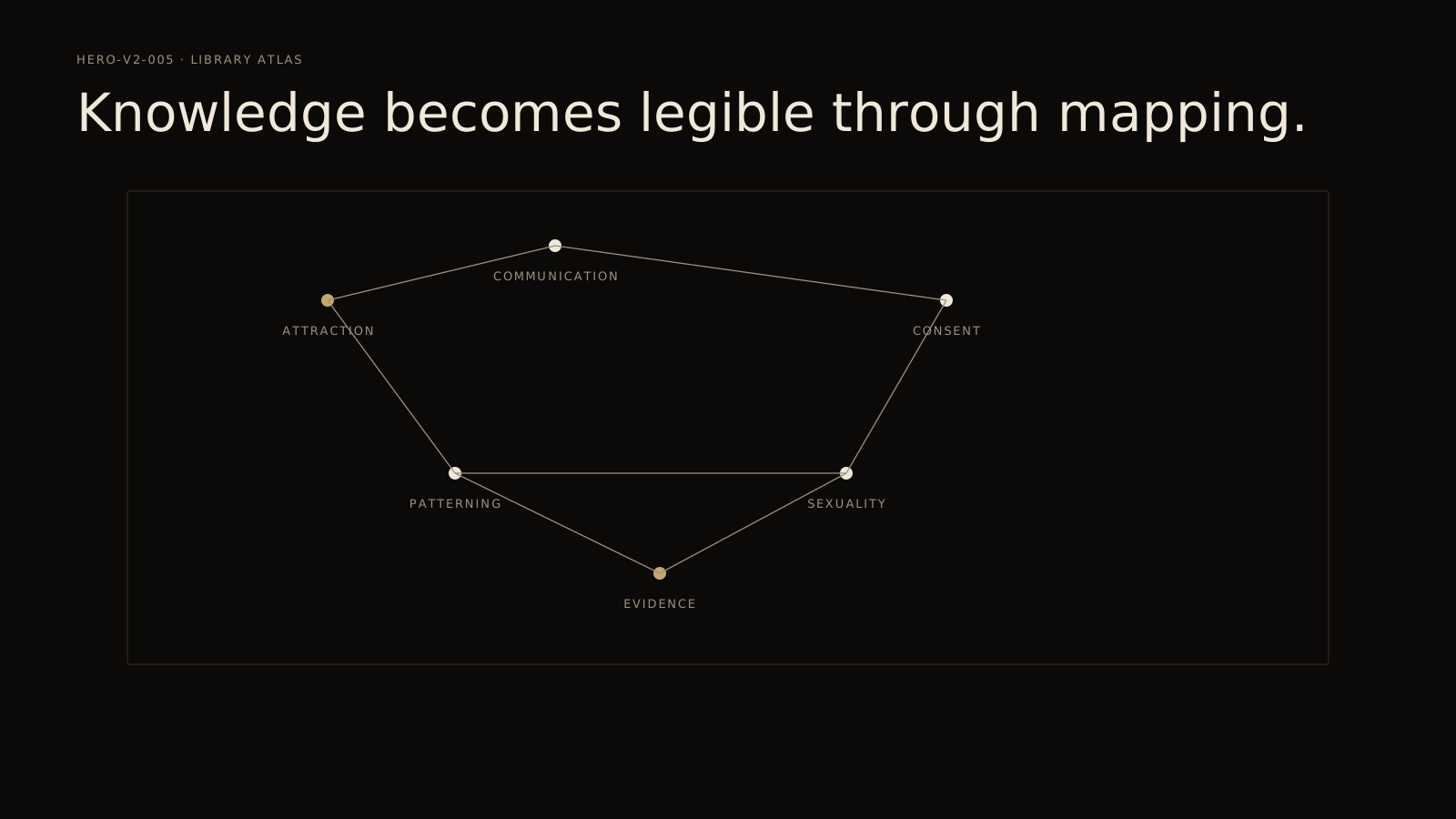
A mapped network connecting attraction, communication, consent, patterning, sexuality, and evidence.

What brought you here?

Choose the closest problem. Each route opens a small, editorially mapped reading set from the real archive.

Start here

Six notes establish how DEZAIR separates observation, inference, uncertainty, reciprocity, consent, and responsible action.

Topics connect. They do not collapse.

Attraction, communication, consent, patterning, sexuality, and evidence overlap—but each asks a different question. Use the map to orient, then enter a public territory below.

Explore all 12 topic domains
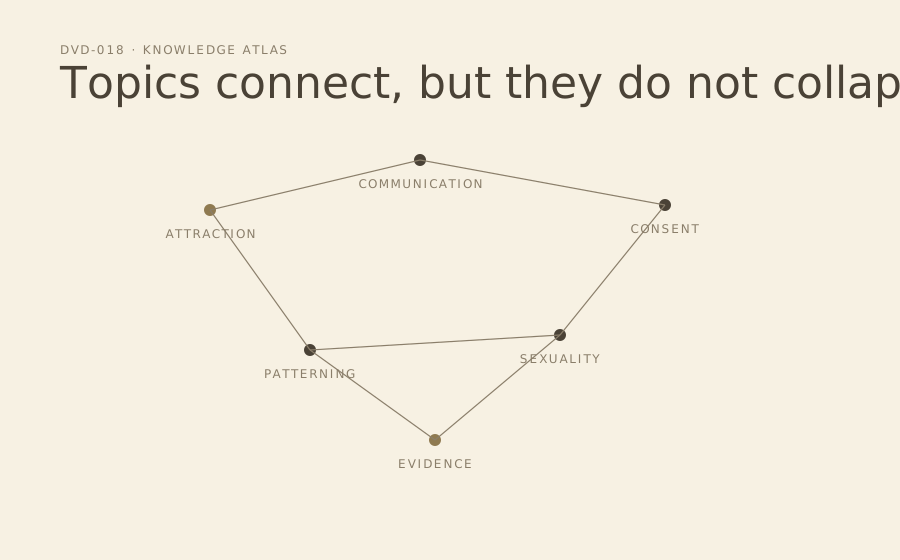
Knowledge atlas connecting attraction, communication, consent, patterning, sexuality, and evidence.
Relationships between territories guide navigation; they do not make one topic interchangeable with another.

Browse by public territory

Publication type describes the editorial form. Territory describes the subject. Depth describes the reading commitment.

01

Read the Interaction

Interpret signals, context, consent, and the meaning of the moment before you act.

Field NoteMutual AttractionDaniel meets Priya at a mutual friend's rooftop dinner. They end up in the kind of forty-minute conversation that skips small talk entirely — a documentary neither expected the other to…Mutuality & ReciprocityCase Analysis · 14 MINStandards NoteBefore You EnterThis is a library about desire, sex, and relationships, built for adults. Most of it reads like you'd expect: practical, evidence-based, direct.…Consent, Boundaries & AgencyQuick Read · 1 MINField Note7 Signals That Feel Like Interest but Usually Aren'tNone of these are meaningless. They're just weaker evidence than they feel like in the moment — and mistaking a weak signal for a strong one is where most bad reads actually come from.Mutuality & ReciprocityQuick Read · 3 MINResearch SynthesisThe Evidence Behind Better IntimacyA reader has been through a dozen articles on this library by now. She's noticed a pattern in the small parenthetical tags scattered through them — (established evidence), (plausible…Observation & InterpretationDeep Read · 9 MINEvidence NoteWhy "I Don't Know Yet" Is a Successful AnswerThree weeks into seeing someone, a reader sits down to figure out, once and for all, whether this is going anywhere.…Observation & InterpretationCase Analysis · 2 MINEvidence NoteIs Body Language Reliable Enough to Know What Someone Wants?A widely repeated statistic — that communication is something like 93% nonverbal, or that body language reveals what someone "really" means regardless of their words — gets used to justify…Observation & InterpretationQuick Read · 3 MINStandards NoteHow to Use This LibraryYou don't need to read this library in order, and you're not expected to have read everything to get value from any one piece.…Observation & InterpretationQuick Read · 2 MINField NoteHow to Know If She Likes You Without Turning Every Signal Into a SignYou keep replaying the same exchange, looking for the detail that finally settles it: does she actually like you, or did you just have one good conversation?Attraction, Pursuit & DecisionCase Analysis · 4 MIN
02

Build Intimacy

Create the conditions for mutual desire, better communication, and embodied connection.

Method NoteThe 25-Minute BuildA five-phase pacing framework for giving arousal enough time to develop before deciding whether escalation is warranted.Touch, Pacing & Intimate ExecutionProtocol · 9 MINField NoteSame Couple, Same Week, Two Completely Different NightsSame two people. Four days apart. One flat night, one fully engaged one. A composite case in what actually changed between them — and what didn't.DesireCase Analysis · 3 MINEvidence NoteSpontaneous vs. Responsive Desire: The Research Behind the Buzzword"Responsive desire is just as normal as spontaneous desire" is the popular version. The actual research found something more specific and more mixed.DesireDeep Read · 3 MINEvidence NoteWhat Touch Research Says About Attunement"Slower and gentler is always better" isn't quite what the research on pleasant touch found. There's a specific velocity range where it actually peaks — and a real debate about why.State, Arousal & AttentionDeep Read · 3 MINField NoteWanting to Want It: The Gap Nobody ExplainsThere's a specific discomfort in wanting to want something and not finding it there. It's common, documented, and not automatically a verdict on the relationship.DesireQuick Read · 3 MINField NoteWhy the Same Touch Means Something Different on a Different DayThe exact same touch, the exact same person, and two completely different reactions on two different days. Here's why that's expected, not a mystery.State, Arousal & AttentionQuick Read · 3 MINMethod NoteWhy "More Foreplay" Isn't Always the AnswerMore foreplay is the reflexive fix for almost every desire complaint. It only works when the problem is actually the one it addresses — and often it isn't.DesireGuide · 3 MINMethod NoteReading Pressure, Pace, and Retreat as InformationWhether touch is landing well isn't a mystery you have to guess at. The body gives continuous, readable feedback — if you know what to actually watch for.Touch, Pacing & Intimate ExecutionGuide · 3 MIN
03

Repair the Pattern

Recognize recurring relational loops and replace them with safer, more honest patterns.

Field NoteDuty Sex: The Quiet Agreement That Is Destroying Both of YouWhy obligation quietly replaces mutual desire, and how to name the contract without turning honesty into pressure.Relationship Patterns & SystemsDeep Read · 9 MINField NoteHe Noticed The Change. He Chose To Slow Down. He Sped Up Anyway.A composite case, walked through the full diagnostic: what broke wasn't understanding. It was one specific step between knowing and doing.Repair & RecalibrationCase Analysis · 3 MINEvidence NoteWhat Performance Anxiety Research Says About "Just Relax""Just relax" assumes anxiety is the whole problem. Research on choking under pressure points at something more specific — and more fixable.Touch, Pacing & Intimate ExecutionDeep Read · 4 MINField NoteYou Knew The Right Move. You Did The Wrong One Anyway.You noticed exactly when to slow down. You knew it clearly. Then you didn't. Here's why that specific gap isn't a knowledge problem, and isn't fixed like one.Capability, Practice & LearningQuick Read · 3 MINMethod NoteThe Three Ways Good Judgment Fails Under Pressure"Try harder" assumes one problem. There are actually three separate ways judgment fails under pressure, and each one needs a completely different fix.Capability, Practice & LearningGuide · 4 MINResearch SynthesisWhy Knowing What To Do Isn't the Same As Doing ItYou can explain exactly what you should have done, five minutes after you didn't do it. That gap has a name, three distinct causes, and none of them are "just anxiety."Capability, Practice & LearningDeep Read · 7 MINField NoteBefore You Read Any of ThisEverything else in this library explains something. This section does something different: it names a specific story people tell themselves about their own desire, relationships, or sex…Relationship Patterns & SystemsQuick Read · 1 MINField Note5 Signs Your Dry Spell Is CircumstantialA stretch without sex doesn't come labeled. Here's a fast way to sort which kind you're actually in, before you either panic over nothing or ignore something real.Sustained Intimacy & Long-Term StewardshipQuick Read · 3 MIN

Reading explains the territory. Your situation may need an instrument.

The Library teaches. Field Desk helps you structure a specific case without pretending to diagnose another person.

Open Field Desk