 DEZAIR

Two days later he still hasn’t texted her, because texting would mean testing something, and testing something would mean risking the discovery that it isn’t there.
That’s the private question underneath almost every version of this search: is anything mutual actually happening here, or am I building a case out of one good hour?
(Daniel and Priya are composites — a pattern drawn from many similar situations, not a documented case.)
The direct answer
One good conversation cannot answer that question by itself. Enjoyment is easy to produce by accident — good lighting, good wine, a topic either person would have enjoyed with almost anyone. Reciprocity is a different thing, and it’s harder to fake, because it isn’t a feeling. It’s a pattern of behavior over time: who keeps something alive when it would be easier to let it drop, who adds effort without being asked, whether warmth shows up again when nobody is performing for an audience.
You don’t need more charm to answer this question. You need to know what to watch for, and how much weight to put on what you see before you know for sure. That’s what this guide is for — not a script for making someone like you, but a way of reading whether they already might, without turning every reply into a verdict.
What this guide covers
This is the entry point to the Attraction & Mutuality pillar. The rest of the library goes deep on each piece below; here, the job is to give you the whole shape of the problem, so the pieces you read next make sense as parts of one model rather than eight disconnected tips.
- Telling warmth apart from mutual interest
- Distinguishing courtesy from genuine participation
- Reading enthusiasm without mistaking it for initiation
- Knowing when ambiguity has produced enough information to act on
- Making sense of signals that contradict each other week to week
- Understanding why adding effort rarely resolves uncertainty
- Recognizing rejection when nobody actually says the word
- Ending pursuit cleanly when the evidence says it’s time
The core model: observe, calibrate, act proportionately
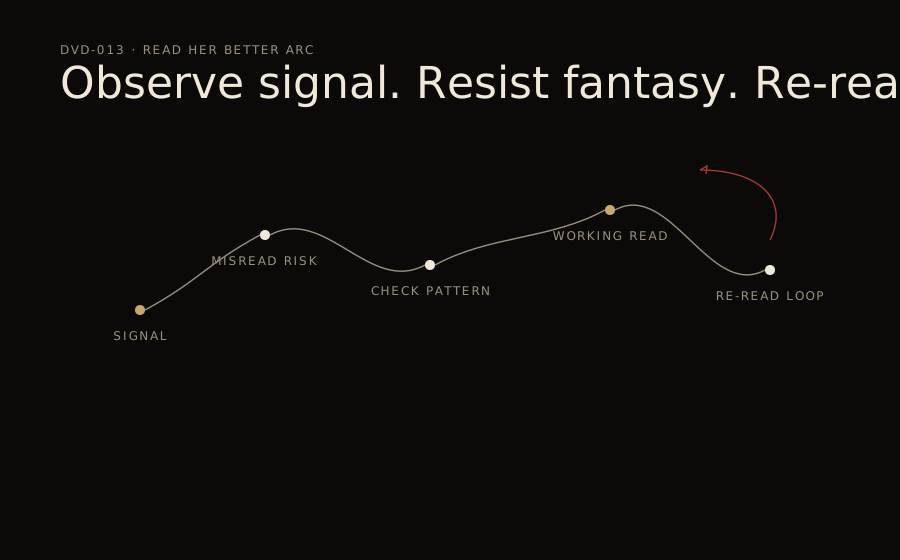
Most bad reads don’t come from stupidity. They come from a very human shortcut: one vivid data point (a long text, a lingering glance, a compliment) gets treated as if it settled the question, because uncertainty is uncomfortable and a single sign is easy to hold onto. DEZAIR’s approach to this — the same discipline the Institute applies to reading any ambiguous social situation — comes down to three moves done in order.
Observe before interpreting. Notice what actually happened, separate from what you hope it meant. “She replied within ten minutes” is an observation. “She’s excited about me” is an interpretation stacked on top of it, and it isn’t the only one available — she might just reply to everyone quickly.
Calibrate against a baseline and a pattern, not a single event. One data point tells you almost nothing on its own. A pattern across multiple, independent kinds of evidence — how she communicates, how she acts in person, whether she does things unprompted — tells you much more. Confidence should rise gradually with corroborating signals, not spike on the first promising one.
Act in proportion to the evidence you actually have. If the evidence is strong and consistent, escalating investment is reasonable. If the evidence is thin or mixed, the correct move is usually to gather more information cheaply — not to commit harder in the hope that commitment will force clarity. Overinvesting before the evidence justifies it is the single most common way this goes wrong.
There’s a fourth piece that’s less comfortable but just as important: sometimes the honest answer is “not yet knowable.” Two weeks of contact is not always enough data, and manufacturing certainty out of insufficient evidence just means you’re guessing with confidence. Holding “I don’t know yet” as a valid, temporary answer — rather than a failure — is itself a skill.
What to actually watch for
Reading reciprocity isn’t about decoding secret signals. It’s about tracking a small number of concrete, checkable things over time, instead of anchoring on one memorable moment.
Initiation. Who starts contact, and how often, when nobody has to? A single instance either way means little; a consistent split over two or three weeks means much more.
Extension. When a conversation could naturally end, does it? Or does the other person add a question, a follow-up, a reason to keep it open?
Personalization. Is what’s said generic — things they’d likely say to most people — or specific to something only the two of you share: an inside reference, a detail from a previous conversation, an observation about you in particular?
Consistency across contexts. Does the pattern hold in person and in text, in a group and one-on-one? Interest that only shows up in a low-cost channel (a text late at night) and never in a higher-cost one (making time to meet) is weaker evidence than interest that shows up everywhere.
Willingly paid cost. Did they rearrange something, however small, to make time or space for you? Effort that costs nothing to give is weaker evidence than effort that required a trade-off.
None of these, alone, proves anything. Together, repeated over more than a single week, they’re the difference between a hopeful narrative and an actual read.
The eight questions this pattern shows up in
1. Warmth is not the same as mutual investment
A single great conversation, even a great string of texts, tells you someone is capable of enjoying your company — not that they’re building something with you specifically. The tell is what happens when you stop supplying the energy. If the conversation dies the moment you stop initiating it, what you had was a pleasant hour, not necessarily a mutual pattern. If it survives your absence — she reopens it, she brings up something from before — that’s a different kind of evidence entirely.
2. Interest or politeness? Watch what happens after courtesy ends
Politeness has a natural stopping point: a reasonable response, a friendly sign-off, engagement that exists because you supplied it. Interest tends to keep going past that point — a follow-up question that wasn’t required, a detail remembered from earlier, a reason invented to keep the thread open. The distinction isn’t about how warm someone sounds in the moment; it’s about whether the warmth needs you to keep pushing it, or whether it has some momentum of its own.
3. Enthusiastic replies are not the same as initiation
This is where a lot of otherwise careful readers go wrong: they weigh how someone responds and never track who starts things. Long, animated replies feel like strong evidence, and they are some evidence — but response quality and initiation are separate variables, and only one of them tells you whether the other person is choosing to invest unprompted. Someone can be a genuinely wonderful conversationalist with everyone and still never be the one to open the conversation.
4. When should you ask her out? Use an evidence gate, not a countdown
There’s no fixed number of good signs that makes an invitation “safe.” What matters is whether continued observation is still producing new information. If every additional week of texting is teaching you nothing you didn’t already know, waiting longer isn’t caution — it’s just delay. An invitation becomes the right move once passive observation has plateaued and a direct step is the only way to get a clearer answer.
5. Mixed signals usually mean you have mixed evidence — not a hidden single truth
When someone is warm one week and distant the next, the instinct is to search for the “real” explanation that reconciles both. Often there isn’t one tidy answer. People are inconsistent for reasons that have nothing to do with you — a hard week at work, unrelated stress, competing priorities. The useful move isn’t to resolve the contradiction into a story; it’s to hold the evidence as genuinely mixed, watch the direction it moves over more time, and resist the urge to commit fully to either interpretation before you have to.
6. Chasing harder rarely fixes uncertainty
When someone feels unsure, a common reflex is to add effort — one more message, one more plan, one more gesture — on the theory that enough effort will finally reveal where things stand. It usually doesn’t. It just means your investment climbs faster than the other person’s, until your own effort is the only thing keeping the interaction alive. Investment should track evidence, not anxiety. If the reciprocal signal isn’t there, more output from your side doesn’t create it — it just delays you noticing.
7. What counts as rejection when nobody says the word
Most disinterest isn’t dramatic. There’s no argument, no clear “no” — just participation that never grows, replies that arrive later and shorter, plans that only happen because you propose them. Waiting for an unambiguous rejection before you’ll accept the pattern is usually waiting for something that was never going to come. Repeated, uncorrected non-reciprocity is itself the answer, even without a single word confirming it.
8. The clean exit
Once the pattern is clear, the hardest message to avoid sending is the one built to recover something — a witty last text, one more attempt engineered to prove you weren’t invested, an ultimatum disguised as a joke. None of these are really for the other person. Exiting well means noticing the pattern, resisting the urge to reinterpret it favorably one more time, not adding a final unmatched effort, and redirecting your attention elsewhere without needing the story to end on your terms.
Applying it: back to Daniel and Priya
Here’s what changes if Daniel actually uses this model instead of replaying the one good hour on a loop.
He stops treating the dinner conversation as the evidence and starts treating it as the opening data point. He sends a normal, low-cost message — nothing engineered, no test disguised as a joke — and watches what comes back: does she reply quickly because she replies quickly to everyone, or does she extend the thread? Over the next two weeks, he tracks initiation (does she ever text first, unprompted), personalization (does she reference anything from the dinner, or from a message he sent three days ago), and consistency (does the same warmth show up if they end up in the same room again, not just over text).
Two weeks in, the picture might go one of three ways. If she initiates, personalizes, and stays consistent, the evidence has moved from “maybe” to “reasonably confident,” and inviting her somewhere specific is a proportionate next step — not a leap of faith. If she only ever responds and never opens anything, the pattern looks like enthusiasm without initiation (question 3 above), and the honest read is that this may be a pleasant acquaintance rather than a mutual pull — worth one direct, low-pressure invitation to convert ambiguity into a real answer, rather than an indefinite guessing game. If the picture stays genuinely mixed — warm some days, flat others — the correct response isn’t to force a verdict; it’s to hold the uncertainty, keep his investment proportionate, and let more time either clarify the pattern or make the disengagement obvious on its own.
None of these outcomes required Daniel to read her mind at the rooftop dinner. They just required him to keep watching after it.
Decision principles worth keeping
- Invest at the rate the evidence justifies — not the rate your hope justifies. Rising effort should follow rising, independent evidence, not the other way around.
- Use evidence gates before big moves. Ask “has more observation stopped teaching me anything new?” before you decide it’s time to invite, escalate, or exit.
- Update instead of defending. When new information contradicts your working theory, the theory should move — not the other way around.
- Let ambiguity stand when it has to. “I don’t know yet” is frequently the most accurate answer available, and it’s a better place to act from than false confidence.
- Weight patterns over peaks. One remarkable interaction is a data point, not a verdict. Repetition across independent contexts is what actually moves confidence.
- Treat consistency as the tie-breaker. When one piece of evidence looks encouraging and another looks discouraging, weight whichever one has repeated more often — not whichever one happened most recently or felt most memorable.
Where this goes wrong most often
The most common mistake isn’t lack of feeling — it’s over-crediting a single signal, especially one that’s easy to remember (a lingering glance, a “you’re so easy to talk to”) while discounting a longer pattern that’s less flattering to notice. A close second: mistaking someone’s general responsiveness for personal initiation, which inflates confidence in people who are simply pleasant with everyone. A third: adding effort specifically because things feel uncertain, which reliably makes the imbalance worse rather than better. A fourth, less discussed: treating an unclear situation as a personal failure that has to be resolved immediately, instead of a genuinely ambiguous state that sometimes needs to be tolerated for a while before it resolves on its own. And a fifth: sticking with whichever interpretation justifies the effort already spent, rather than updating when new evidence points the other way — the same sunk-cost pull that distorts decisions everywhere else in life shows up here too.
A note on the examples in this guide. The scenes above use “he” and “she” because that’s the framing of the reader question this guide is built to answer first — but the underlying pattern (initiation, extension, personalization, consistency, cost) isn’t specific to any one gender or orientation. Nothing about reciprocity requires a particular pairing to work the way it’s described here. Where this guide uses gendered language, treat it as illustrative shorthand, not a claim about how attraction works differently by gender — that would be a much stronger claim than the evidence supports.
Evidence note. The idea that people tend to like those who show liking toward them — the reciprocity of attraction — is a long-studied, well-supported pattern in social psychology (established evidence). That perceived interest can itself increase attraction, sometimes independent of a partner’s actual traits, is also reasonably well documented (established evidence). The specific five-marker model used above — initiation, extension, personalization, consistency, and willingly paid cost — is DEZAIR’s own synthesis for organizing those findings into something usable in the moment, not a peer-reviewed instrument (DEZAIR synthesis). Nothing here should be read as a way to predict any individual person’s behavior with certainty; it’s a framework for weighting evidence, not a guarantee.
Frequently asked
Does eye contact mean she’s attracted to me? Not by itself. Sustained eye contact can indicate interest, but it can also reflect personality, cultural norms around conversation, or simple attentiveness. Treat it as one weak signal among many, not a standalone verdict — the full breakdown of body-language claims lives in Does Eye Contact Mean Attraction? Not by Itself.
How many “good signs” do I need before I ask her out? There’s no magic number. The better question is whether continued waiting is still producing new information. Once it isn’t, an invitation is a better use of time than more observation — see When Should You Ask Her Out? Use an Evidence Gate, Not a Confidence Trick.
What if she’s just a naturally warm person with everyone? Then her baseline warmth tells you less than you think, and you need to look for signals that are specific to you rather than generic to her personality — initiation, personalization, and consistency matter more than raw friendliness in that case.
Is it needy to ask directly instead of reading signals? No. Direct communication generally outranks inference when the two conflict — that priority is covered fully in the Communication & Consent pillar. Reading signals is for the uncertainty before a direct conversation is possible, not a permanent substitute for one.
Can two genuinely interested people still send each other mixed signals? Yes. Nervousness, competing priorities, fear of being the one who cares more, or simply a bad week can all produce ambiguous behavior even when interest is real and mutual on both sides. That’s exactly the situation Mixed Signals Usually Mean You Have Mixed Evidence is built to walk through in more depth.
The takeaway
Mutual interest shows up as a pattern that survives your absence, not a peak that requires your effort to sustain it — read the pattern, not the peak, and let your investment follow the evidence instead of leading it.
Where to go next
If you recognize the specific situation, the deeper, single-question guides in this pillar go further than a hub piece can:
- How to Know If She Likes You Without Turning Every Signal Into a Sign
- Interest or Politeness? The Difference Is What Happens After Courtesy Ends
- Why Enthusiastic Replies Are Not the Same as Mutual Investment
- When Should You Ask Her Out? Use an Evidence Gate, Not a Confidence Trick
- Mixed Signals Usually Mean You Have Mixed Evidence
- Why Chasing Harder Rarely Fixes Uncertainty
- What Counts as Rejection When Nobody Says ‘No’ Directly?
- The Clean Exit: How to Stop Pursuing Without Anger, Games, or a Last Attempt
If the pattern you’re facing is less about whether interest exists and more about what to do with mixed or hesitant signals once something has started, the next pillar — Reading the Moment — picks up from here. If the gap you’re feeling isn’t about reading someone else but about calibrating your own confidence and next move, that’s what DEZAIR’s Foundation and Pursuit training is built to train directly, once a guide alone stops being enough.