 DEZAIR

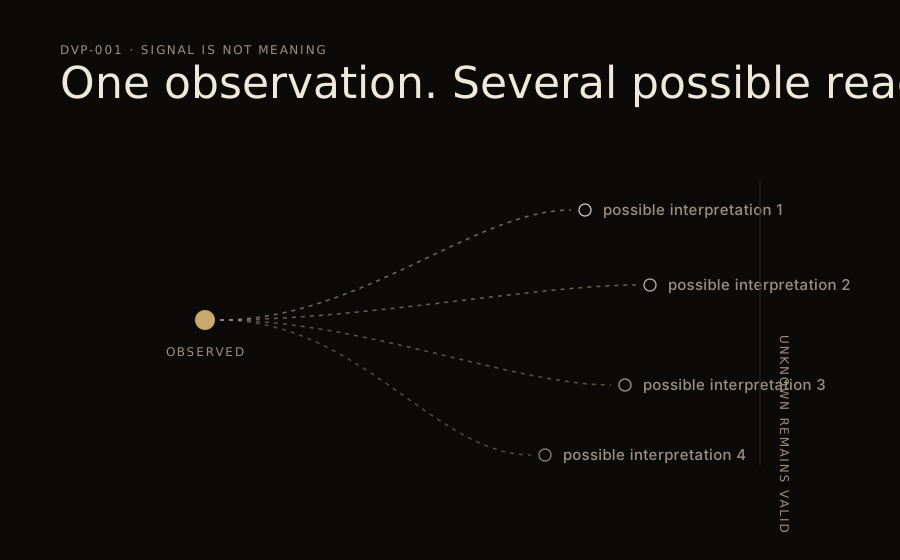
The bad advice this corrects
Most advice in this category collapses into one of two failure modes. One tells you to trust your gut, follow the vibe, just know — treating reading another person as an intuitive gift some people have and others don’t. The other hands you a rulebook: do X, she’ll respond with Y, escalate on schedule Z — treating a person as a predictable system with a known input-output map. Both skip the actual skill.
The DEZAIR standard
“Read, don’t guess” means: observe specific, real behavior before forming a belief about what it means; hold that belief in proportion to how much evidence actually supports it; and update the belief when new evidence arrives, rather than defending the first story you told yourself. It is not a synonym for “trust your intuition,” and it is not a synonym for “follow a script.” It’s a discipline for converting attention into calibrated confidence — nothing more mystical, and nothing more mechanical, than that.
Why this is the actual standard
Guessing happens two ways, and both feel like reading from the inside. The intuitive guess feels like reading because it’s fast and confident — but fast, confident impressions are exactly what unchecked bias and wishful thinking feel like too, and there’s no internal signal that reliably tells the difference between a good intuition and a convenient one. The scripted guess feels like reading because it produces a specific, actionable prediction — but a script trained on “what usually works” is making a claim about a generic person, applied to a specific one, and treating that generic prediction as though it were observation of the actual person in front of you.
Reading, in the sense this library means it, requires three things a guess skips: noticing the actual, specific behavior rather than the story you’ve already built about it; checking that behavior against a pattern rather than a single instance; and holding your resulting belief as provisional, genuinely open to being wrong, rather than as a conclusion you now need to defend.
What this looks like in practice
Consistent with the standard:
- Noticing that someone hasn’t initiated contact in two weeks, and treating that as one data point to add to others, not an immediate verdict
- Updating a belief about someone’s interest when their behavior changes, even if it contradicts a story you liked better
- Saying “I don’t have enough information yet” as a genuine, comfortable answer rather than a failure to resolve
Inconsistent with the standard:
- “I just had a feeling she wanted me to keep going” as the entire basis for escalating, with no actual check
- Applying a general rule (“women like confidence,” “always wait three days”) to a specific person as though it were information about them specifically
- Holding onto an early read after real, repeated evidence has pointed the other way, because updating would mean admitting the first read was wrong
Edge cases worth naming
Intuition isn’t banned — it’s just not evidence on its own. A hunch is a reasonable place to start looking harder, not a reasonable place to stop. Likewise, general patterns aren’t useless — they’re a reasonable prior to hold loosely until specific evidence about this specific person either confirms or overrides them. The discipline isn’t “ignore intuition and general patterns.” It’s “don’t let either one substitute for looking at what’s actually in front of you.”
The standard
Read, don’t guess means: what you believe about another person should be built from what you’ve actually observed about them, weighted by how much of it there is, and open to changing the moment better evidence shows up — not a feeling you trusted because it was fast, and not a rule you trusted because it was generic.