 DEZAIR

That interruption isn’t hedging. It’s the entire reason anything else in this library is worth trusting.
The direct answer
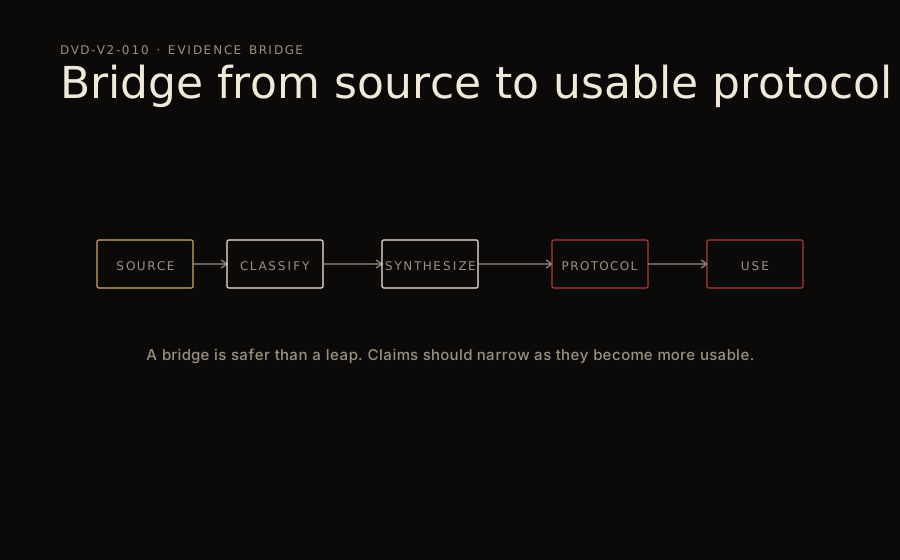
Most advice in this category — dating, sex, relationships — is delivered with exactly one confidence level: total. A claim about brain chemistry, a claim about what “all women want,” and a pure guess dressed up as a rule all arrive in the same flat, certain voice, because certainty sells better than honesty and nobody’s checking. This library does something different on purpose: every claim that touches physiology, psychology, or a universal pattern gets labeled by how well it’s actually supported, using five specific categories. That labeling is slower to write, less satisfying to read, and considerably more useful, because it tells you which parts of what you just read you can lean on hard, and which parts are your starting hypothesis, not your answer.
What this guide covers
- The five evidence categories, and what each one actually licenses you to do with a claim
- Why “DEZAIR synthesis” isn’t a lesser category than “established evidence” — just a differently sourced one
- Why some real, important questions are genuinely unknown, and why that’s a better answer than a confident guess
- How claims get revisited over time, rather than fixed once and left alone
- Why claims about “everyone” or “all men” or “all women” get held to a higher bar than specific, situational ones
- The difference between hedging on truth and being direct on action — this library does the second while refusing the first
The core model: five categories, one purpose
Established evidence. A finding well-replicated across independent research, broadly accepted in the relevant field. This is the strongest category available, and it still isn’t a claim about you specifically — established evidence describes patterns across many people, not a guarantee about any one person’s experience. The reciprocity of attraction, the sexual side effects of SSRIs, the basic physiology of arousal and adrenaline overlap — these are established. What individual variation looks like within them usually isn’t.
Plausible mechanism. A real, evidence-consistent explanation for why something works, that hasn’t been definitively nailed down for this exact application. Excitation transfer theory explaining why fear and arousal can blur together is real, tested psychology — its specific application to a particular kind of fantasy is a plausible, reasonable extension of it, not itself a directly tested finding.
DEZAIR synthesis. This library’s own framework for organizing scattered, real findings into something usable in an actual moment — the five-marker reciprocity model, the “hurt versus harm” framing for pain and pleasure, the way this pillar’s own doctrine gets applied across contexts. Synthesis isn’t a lesser category than established evidence; it’s a different kind of claim entirely — one this library is directly responsible for and stands behind, built from real research rather than independently tested as its own unit. Labeling it as synthesis, rather than passing it off as settled science, is what makes it something you can actually evaluate rather than just accept.
Hypothesis. An informed, reasonable guess that hasn’t been meaningfully tested yet. Worth having, worth stating plainly, and worth treating as exactly what it is — a starting point for your own observation, not a conclusion to build a decision on.
Unknown. Genuinely unresolved. No confident answer currently exists, and no amount of persuasive writing changes that. Why some people eroticize pain and others don’t. What exact anatomical structure sits behind reported G-spot sensitivity. Whether a specific person’s low desire this month is circumstantial or structural, before anyone’s actually looked. Naming these as unknown, rather than manufacturing an answer, is a feature of this library, not a gap in it.
Why the categories matter more than the advice itself
A claim’s category tells you how hard to lean on it. Established evidence can bear real weight in a decision. A hypothesis can inform curiosity, not commitment. Treating them identically — which almost all advice in this category does, by refusing to distinguish them at all — is how someone ends up making a real decision on the strength of an untested guess without ever knowing that’s what they did.
Synthesis isn’t inferior evidence — it’s honestly sourced evidence. A framework built by combining real findings into something practical is exactly what good applied work looks like everywhere, from medicine to engineering. The failure mode isn’t building synthesis. It’s presenting synthesis as independently proven science, which is a different, dishonest claim about where the idea actually came from.
Some genuinely important questions don’t have confident answers yet, and that’s fine. A library that admits this loses a little of the swagger that sells confident-sounding advice. It gains something more durable: a reader who can actually tell, over time, which parts of what they read held up and which didn’t — which is only possible if the original claim was honest about its own uncertainty in the first place.
Evidence labels aren’t static. Research changes. A claim marked established evidence today can be revised as better research arrives; a hypothesis can graduate to plausible mechanism once real testing exists. This library commits to revisiting evidence-adjacent claims over time rather than treating a label as permanent the day it’s written — the update discipline covered directly in How We Evaluate Intimacy Advice Before Publishing It.
Claims about “everyone” need more evidence than claims about “this specific situation.” A universal claim — about a whole gender, a whole relationship stage, a whole category of person — is a much bigger claim than it sounds like, and it gets held to a correspondingly higher bar here. Gendered examples are used throughout this library because they’re often the clearest way to illustrate a pattern; a claim that the pattern applies to absolutely everyone, always, is a separate and much stronger claim that needs its own separate support.
A worked example
Take a claim from elsewhere in this library: that pain can register as pleasure inside a negotiated, consensual context. Broken into its actual evidence components rather than stated as one flat fact, it looks like this. That endogenous opioids and adrenaline are released during intense physical sensation is established evidence — well-documented, broadly replicated. That the brain assigns meaning to generic physiological arousal based on context is also established evidence, though from research on emotion generally, not this specific application. That trust and consent are the mechanism converting a threat signal into a pleasurable one, specifically in negotiated sensation play, is a plausible mechanism — a reasonable, evidence-consistent extension of the first two findings, not yet directly tested as its own claim. And why any specific individual does or doesn’t experience this is, honestly, unknown.
Stated as one confident sentence — “pain becomes pleasure through trust and endorphins” — all four of those claims get flattened into the same certainty, and a reader has no way to tell which part is settled science and which part is this library’s own reasonable inference. Broken apart with labels, the same information becomes something a reader can actually calibrate their trust against.
Where this doesn’t apply
Not every claim in this library needs a label. Practical suggestions — try this position, use this phrasing, consider this pacing — are recommendations to test, not claims about how bodies or minds universally work, and they don’t carry the same burden of evidence as a physiological or psychological assertion. The labeling discipline applies specifically where R11 requires it: physiology, psychology, medical-adjacent claims, and anything stated as universally true. A suggestion to try something is inherently an invitation to gather your own evidence, not a claim requiring someone else’s evidence first.
Decision principles for reading this library
Weight established evidence heavily when a decision actually rests on it. Treat hypothesis and unknown as invitations to gather your own evidence, not as final answers standing in the way of one. When a claim would change meaningfully if it turned out to be wrong, check its label before acting on it as though it were certain. And don’t mistake directness of action for certainty of claim — this library will often tell you exactly what to try next, stated plainly, while being equally plain that the underlying mechanism is still only a hypothesis. Those two things are not in tension; a clear next step doesn’t require a settled science to justify trying it.
Where this goes wrong
The most common failure, across this entire category of advice, is flattening every claim to the same confident register — which teaches readers to distrust obvious guesses and confirmed findings in exactly the same amount, because nothing ever taught them the difference. A close second: assuming hedged language signals weak, low-value advice, when it’s frequently the more reliable article precisely because it was honest enough to admit its own limits. A third: reading a piece, remembering only the practical takeaway, and discarding the evidence label that told you how much weight that takeaway could actually bear — understandable, and still a real loss of the most useful part of what you read.
Frequently asked
Isn’t labeling something “DEZAIR synthesis” just a way to avoid being held accountable for the claim? It’s closer to the opposite — labeling a claim as this library’s own synthesis means owning it explicitly, rather than borrowing the unearned authority of “studies show” for something that’s actually an applied framework this library built and is responsible for.
If the practical advice is often the same regardless of the label, why does the label matter? Because the label tells you what happens if new evidence contradicts it. A hypothesis that turns out wrong is expected and low-cost to revise. A claim wrongly presented as established evidence that turns out wrong costs the reader’s trust in everything else the source has said — the label is what lets a claim be corrected without that collapse.
How are these labels actually assigned — is there a rigorous process, or is it a judgment call? Both, honestly — real research gets checked against the specific claim being made, and where the fit is genuine synthesis rather than direct evidence, it’s labeled as such. The actual editorial process behind this is covered in full in How We Evaluate Intimacy Advice Before Publishing It.
Where to go next
If the doctrine behind “read, don’t guess” itself is what you want explained, start with What DEZAIR Means by ‘Read, Don’t Guess.’ If you want the specific rule for how consent claims are evaluated within this framework, see The DEZAIR Consent Hierarchy. If you’re wondering why this library refuses to hand you a single number to summarize a whole person’s interest, see Why DEZAIR Does Not Use Attraction Scores.