 DEZAIR

The bad advice this corrects
Most advice in this category is published because it sounds compelling, not because it passed any check. A confident voice, a satisfying story, a clean rule — those are the actual filters most content in this space runs through, and none of them are checks on whether the advice is true, safe, or actually useful once someone tries to apply it to a real, specific person.
The DEZAIR standard
Every piece in this library is built against a fixed set of structural and editorial requirements before it’s considered finished — not a vibe check, an actual checklist, applied the same way regardless of topic. Naming the checklist here, plainly, is itself part of the standard: a library asking readers to trust its evidence discipline should be willing to show the discipline, not just claim it.
The structural requirements every piece is built against
The problem comes before the framework. A piece has to name a real reader situation in plain language before it introduces any of this library’s own vocabulary or models — recognition first, jargon second, never the reverse.
The direct answer arrives early. Search-driven pieces in particular are required to deliver their actual answer within the first stretch of text, rather than making a reader scroll through preamble to reach the point.
Every story has to do real work. A scene or example is only included if it introduces an actual decision, contradiction, or cost — if removing the story would change nothing about the argument, the story doesn’t belong in the piece.
One piece, one job. Each article is built to answer one specific reader situation with one answer and one next step — not to cover a topic exhaustively in a single sprawling piece.
Concrete over generic. Pieces are required to use specific scenes, real decisions, and genuine counterexamples rather than vague, interchangeable filler that could apply to any topic in this space.
What people search for isn’t automatically what they’re told. A piece can be built around the exact phrase someone types into a search bar without letting that phrase dictate an answer that contradicts this library’s actual standards.
Links follow the next real question, not just the category. Internal references point toward whatever a reader would naturally want to know next, rather than simply toward other pieces tagged with the same topic.
Any mention of training or products is earned, not assumed. A product reference only appears once a piece has established that understanding the concept alone genuinely isn’t the same as building the underlying capability — never before the piece has delivered real value on its own terms.
Explicit content has to be doing a specific job. Detail that could be read as sexual content is only included when it clarifies something — sensation, consent, pacing, anatomy, execution — never included purely for its own sake.
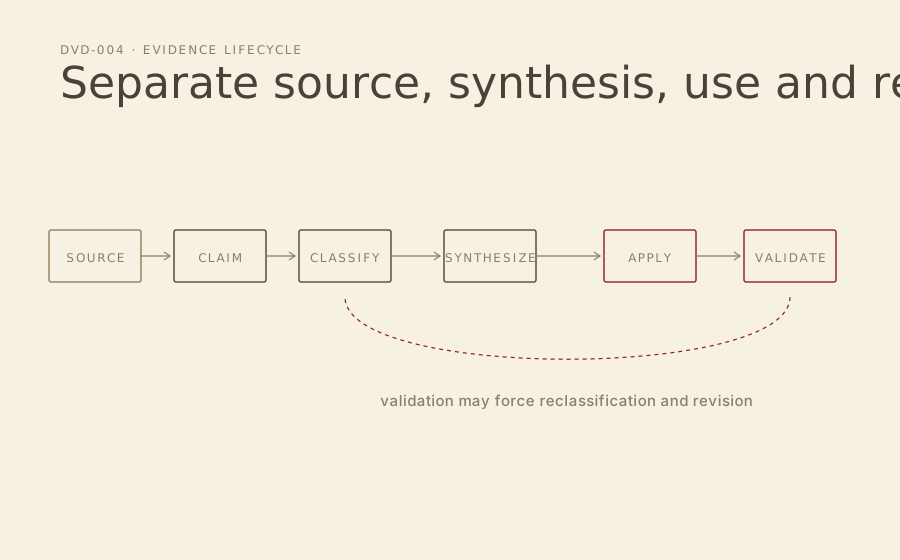
Every claim about physiology, psychology, health, or a universal pattern gets an evidence label. This is the discipline covered in full in The Evidence Behind Better Intimacy — established evidence, plausible mechanism, DEZAIR synthesis, hypothesis, or unknown, applied consistently rather than selectively.
Evidence-adjacent and health-adjacent content gets revisited, not fixed permanently. Claims in these categories are treated as subject to review over time, not written once and left unquestioned indefinitely.
Universal claims need real support — gendered examples don’t. Using “he” and “she” to illustrate a pattern clearly is allowed throughout this library. Claiming the underlying pattern applies to literally everyone, without qualification, is a stronger claim that needs its own separate evidence.
Composite cases are disclosed as composite. Any illustrative scene not drawn from a specific, permission-granted, documented source is labeled as a composite — a pattern, not a real individual’s story — every time.
One canonical piece owns each broad topic. Rather than publishing several competing pieces on the same broad question, one piece is designated the canonical answer, and related pieces are built to target genuinely distinct angles that link back up to it.
Why this level of structure, specifically
None of these requirements exist for their own sake — each one closes a specific failure mode common elsewhere in this category: burying the actual answer, padding with decorative stories, treating one topic as several to inflate a library’s apparent size, letting product interest distort the advice, or letting confident language substitute for actual evidence. A checklist this specific is harder to fake than a general commitment to “quality,” which is exactly the point.
The standard
If a piece in this library doesn’t meet every one of these requirements, it isn’t published — not because the checklist is sacred, but because each item on it is the direct fix for a specific, common way advice in this category goes wrong, and skipping any one of them reopens exactly that failure mode.